How water research will help restore a rainforest
An investigation into water above and below ground in Maleny will help restore rainforest and wetland ecosystems at the Sunshine Coast Ecological Park.

In Maleny, through remnant rainforests and former pasture, through creeks and dams and underground, water quietly weaves a tapestry of stories.
Now those stories will be told for the first time, with groundbreaking research that will help shape how we restore a local rainforest and wetland or manage precious natural areas and even our drinking water.
Dr Agustin Cabrera from Griffith University’s Australian Rivers Institute is leading the pioneering study to map the characteristics of both surface and groundwater across the Sunshine Coast Ecological Park site and the neighbouring Mary Cairncross Scenic Reserve.
“When people look for life, out in the universe, the thing they’re looking for is water,” Dr Cabrera said.
“That’s how basic, how essential water is to life.”
Dr Cabrera’s work, which uses environmental tracers and isotopes, will be the first of its kind completed in the area, providing local baseline data we’ve never seen before.
Water signatures trace a journey and tell a story
Water is the lifeblood for nature and humans alike, and like any specialised blood test, its study offers endless insights.
Chemical and biological clues define each area, from healthy rainforest to farmland and areas under restoration, such as the Sunshine Coast Ecological Park.
These characteristics make up a “signature” that allows water to be traced, even as it picks up new characteristics along its journey, passing through new landscapes and collecting minerals, DNA (any living or dead organism) and synthetic molecules.
Water can provide the first indication of change coming, and it can trace where that change is coming from.
For example, testing can reveal pesticides or other compounds, either by detecting them directly or finding organisms that "feed" on them.
Dr Cabrera hopes to also sample water from various points all the way to Baroon Pocket Dam.
By doing this, he can trace its unique story, how it is shaped by the environments it passes through and shapes them in turn.
How research will guide restoration at Ecological Park
Sunshine Coast Council is progressing the Sunshine Coast Ecological Park, which seeks to restore a large portion of the 65 hectares of cleared pasture land on Jinibara Country to rainforest and wetlands, as a community hub and living laboratory for scientific study, cultural storytelling and learning.
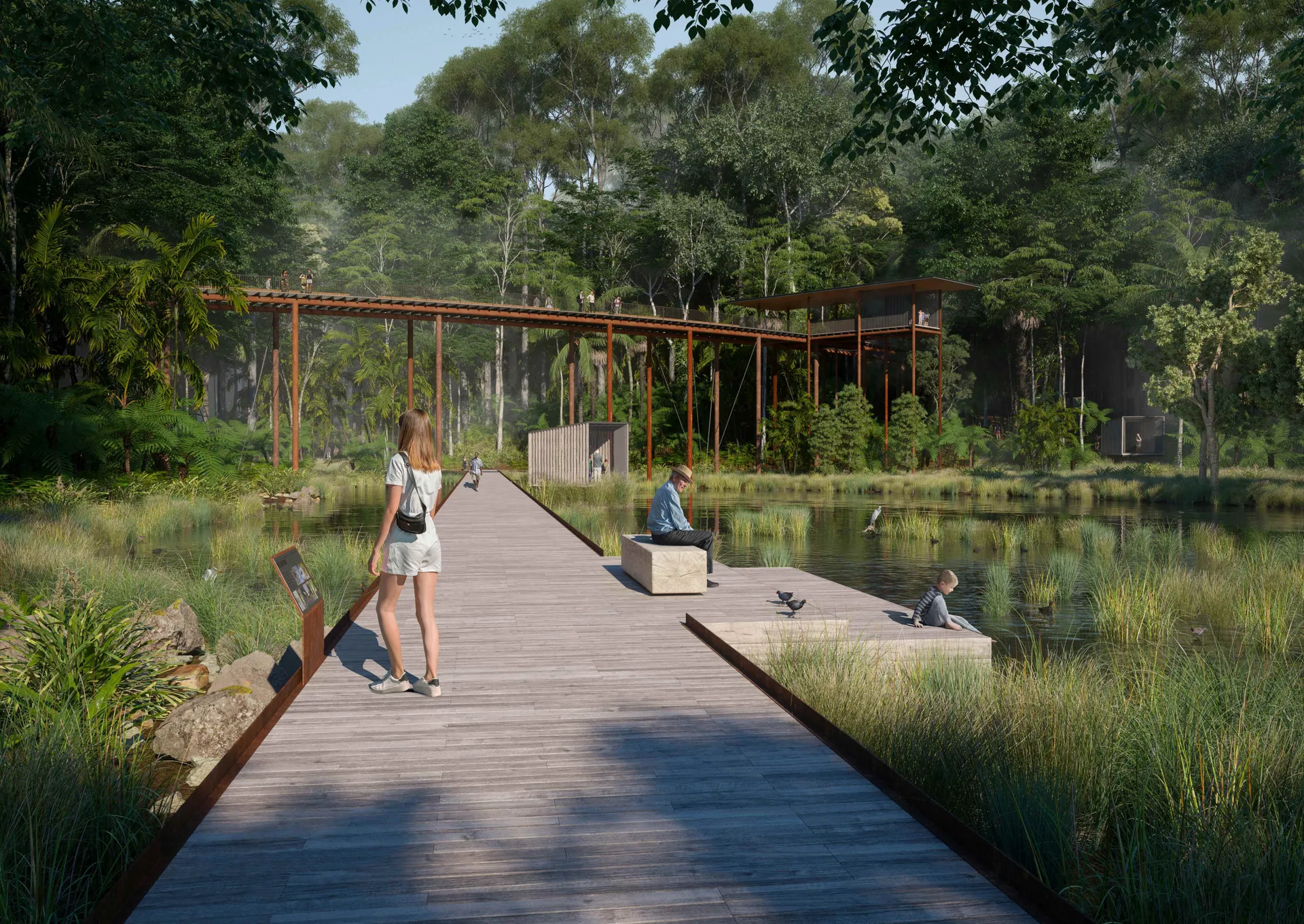
Unlike traditional parks, the Sunshine Coast Ecological Park considers people, wildlife, resources and vegetation equally, balancing recreation with ecological restoration.
With the project currently in early site investigations and design planning phase, the findings from Dr Cabrera’s research will help guide the restoration of the Ecological Park, uncovering the inorganic and organic profile of its water now and what it could become as a healthy rainforest.
It will also demonstrate how restoring rainforests at the Ecological Park could benefit ecosystems and people downstream, far beyond the borders of the site.
Ultimately, caring for water means caring for everything in our interconnected Sunshine Coast Biosphere, including ourselves.
“The care that we take consciously when we live in these environments – because whatever we do, it does affect the air and definitely the water – it will eventually come back to us,” Dr Cabrera said.
This work is a reminder that restoring a rainforest is far more complex than just planting trees.
From the building blocks like water and landscape, to the pollinators and predators, and finally the fungi and other decomposers that restart the cycle, all are connected and require understanding.
Find out more about the Ecological Park
Visit the project webpage to find out more about the project and subscribe for future project news updates.